


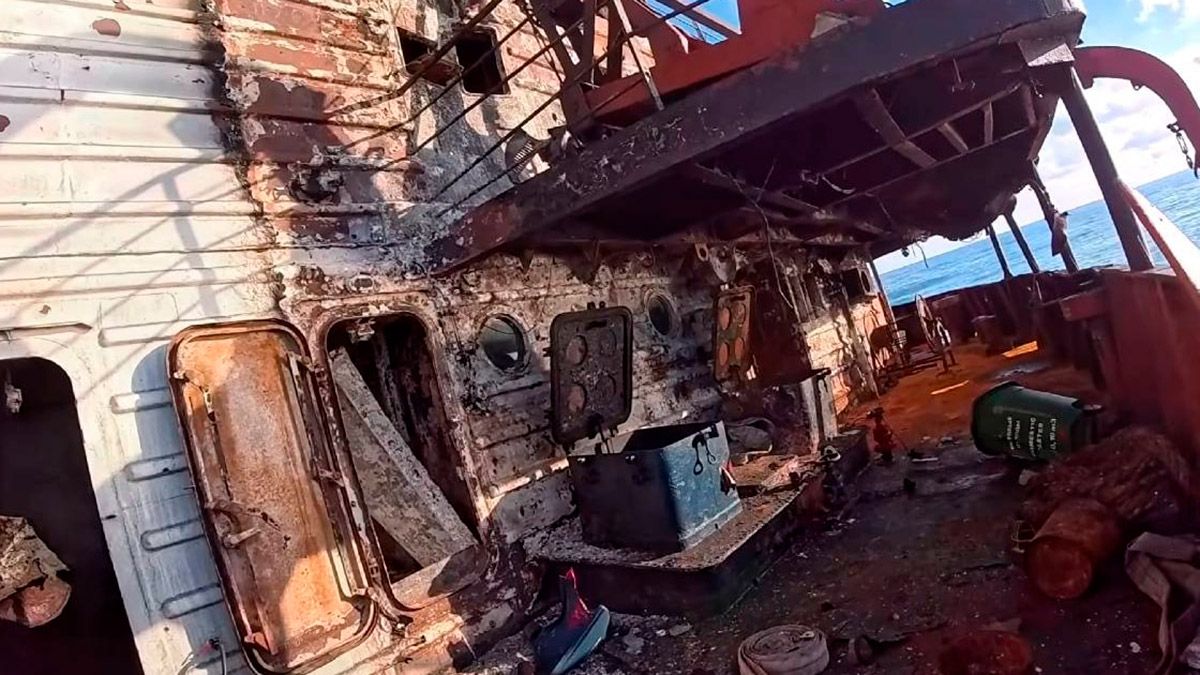
At least 25 ships of Turkish owners have been damaged in the Black Sea since the end of June. Ankara is increasingly demanding to stop attacks on civilian shipping and has sent a draft memorandum to Moscow and Kyiv, but so far has avoided measures that could lead to a direct military clash.
Briefly about the main thing
- At least 25 ships of Turkish owners have been hit since the end of June, four of them flying the Turkish flag.
- According to a Turkish defense source, in August alone, the Black Sea was attacked. almost 90 merchant ships.
- Türkiye handed over to Russia and Ukraine a draft memorandum on stopping attacks on civilian shipping.
- Vessels of Greek interests also suffered, but the public reaction of Athens is so far much more restrained than the Turkish one.
- Ankara is not moving towards military escort of the merchant fleet, as this could lead to a direct clash with Russia or Ukraine.
Content: Why is Türkiye outraged? · Greek ships · what Ankara offers · why is there no military protection · is there a chance for an agreement
25 Turkish ships – the problem has already become systemic
Türkiye, Karadeniz’deki saldırıları sona erdirecek bir teklifi Rusya ve Ukrayna’ya gönderdi https://t.co/xscxIjlgzn
— Sözcü (@gazetesozcu) September 17, 2026
According to AFP, citing industry representatives, since the end of June there have been strikes in the Black Sea at least 25 ships owned by Turkish owners. Four of them flew under the Turkish flag.
The scale of the problem is much wider. A Turkish defense source said that Almost 90 ships were attacked in August alone. Strikes are taking place in areas of both Russian and Ukrainian ports, and commercial shipping is increasingly finding itself directly in the combat zone.
Ankara has repeatedly expressed dissatisfaction. After attacks on ships Leader Bordo Mavi And Leader Kocatepe On August 26–27, the Turkish Foreign Ministry even called the Ukrainian ambassadorstating the need to ensure the safety of people, property, shipping and the environment.
Earlier, Turkish Foreign Minister Hakan Fidan had already suggested that Moscow and Kyiv stop attacks on the merchant fleet. “Athens News” wrote about this in the material “Black Sea Truce: Will Turkey be able to stop the war against shipping”.
Greek ships were also under attack
This problem also affects Greece, one of the world’s largest shipping nations.
In August, a Greek cargo ship was hit near Novorossiysk ANNA S. The resulting fire practically destroyed the ship, but all 21 crew members were saved.
In early September, a drone attacked a tanker Siren managed by the Greek company Eurotankers from Piraeus. The impact hit the aft superstructure in the area of the crew quarters. “Athens News” talked about this in detail in the material “A Ukrainian drone attacked a Greek tanker in the Black Sea”.
However, there is a noticeable difference in the response of the two countries. Türkiye systematically raises the issue of the safety of its merchant fleetmakes public statements, calls diplomats and proposes a separate agreement to Moscow and Kyiv.
There has not yet been a comparable public diplomatic campaign from Athens. Individual statements were made, but the issue of attacks on ships of Greek interests did not become an independent prominent topic in Greek foreign policy.
Ankara proposes new mechanism
Now Türkiye has moved from general calls to a specific proposal. According to AFP, Moscow and Kyiv received draft memorandum to stop attacks on civilian ships.
The Turkish idea draws partly on the experience of the 2022 Black Sea grain deal. Ankara also proposes to conduct commercial ships as much as possible along the territorial waters of Turkey, Bulgaria, Romania and, with the consent of Tbilisi, Georgia.
The reason is simple: the less time a ship spends on the open sea and directly in a potential combat zone, the lower the risk of attack.
The economic problem is becoming more serious. 18 September London Joint War Committee expanded the zone of increased military risk to almost the entire Black Sea. The territorial waters of Turkey, Bulgaria, Romania and Georgia remain outside its borders.
Why doesn’t Türkiye protect its ships with warships?
Against this background, a logical question arises: if dozens of ships of Turkish owners have already been damaged, why doesn’t Ankara organize military escort for them?
Apparently, it’s not a lack of opportunity. Türkiye has a large navy and is capable of organizing escort for commercial vessels.
But such a move would dramatically change the nature of the country’s participation in the conflict.
If a Turkish frigate is escorting a merchant ship to a Russian port and opens fire on a Ukrainian drone, there is a risk direct clash between Turkey and Ukraine. If a Turkish ship has to repel a Russian attack near the Ukrainian coast, a similar risk arises in relations with Moscow.
Ankara is clearly seeking to avoid both scenarios for now. Türkiye is trying to simultaneously maintain relations with Russia and Ukraine, comply with the regime of the Montreux Convention and prevent further militarization of the Black Sea.
Therefore, instead of armed convoys, she proposes to agree on rules that both warring parties undertake to comply with.
The agreement remains only a proposal for now.
The main weakness of the Turkish plan is obvious: it will work only with the consent of Moscow and Kyiv.
Russia has previously been negative about the idea of a separate Black Sea truce without addressing broader issues of war and sanctions. Ukraine, in turn, continues to view Russian maritime logistics as part of the enemy’s military and economic infrastructure.
Thus, Türkiye finds itself in a difficult position. Its merchant fleet is already suffering direct losses, Ankara is expressing increasingly noticeable irritation, but the transition to forceful protection of its own ships could drag the country into a conflict that it is trying to avoid.
Editorial comment
The situation is looking increasingly contradictory. Civilian ships of third countries have actually become hostages of the war, and diplomatic protests have so far had little effect on what is happening. Türkiye is at least trying to create a separate mechanism to protect merchant shipping. Greece, despite attacks on ships of Greek interests, acts much less noticeably.
At the same time, Ankara is still faced with the main choice: diplomatically protect their ships or physically ensure their safety. The second option inevitably increases the likelihood of a direct clash with one of the warring parties. Judging by Turkey’s current policy, it is precisely this risk that it is not yet ready to accept.
More Stories
Trump buys Russian diesel while Ukraine loses ports and metallurgy – NYT
The US offered to take control of Russia’s frozen assets – Europe refused
Maritime war of sanctions: France detained a tanker, Moscow warns of a blockade of the Baltic